EVERY DAY IS A BLACK FRIDAY HERE AT THE OFFICE CHAIR MAN
SUMMER 2026 OFFER! (Ends 30 September 2026) Qty 1–5 5%, 6–10 10%, 11–15 15%,16–20 20%, 21+ 25% Saving.

Providing a suitable office chair is an important part of an employer’s responsibilities when staff use display screen equipment. However, DSE compliance is not simply a matter of buying a chair labelled “ergonomic” or “DSE compliant”. The chair must form part of a workstation assessed for the individual using it.
In Great Britain, the Health and Safety (Display Screen Equipment) Regulations 1992 require employers to protect workers who use display screen equipment daily for continuous periods of an hour or more. This includes assessing the workstation, reducing risks, providing training and planning breaks or changes of activity. Northern Ireland has equivalent DSE requirements and guidance administered by HSENI.
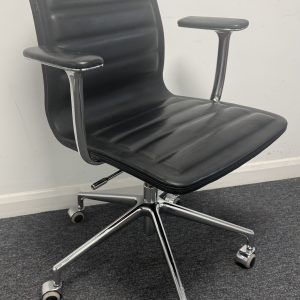
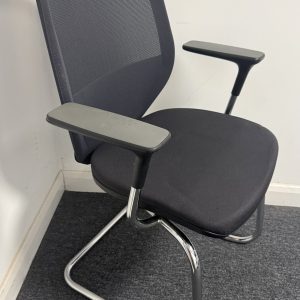
At The Office Chair Man, we supply refurbished office seating including DSE, task and orthopaedic chairs. This guide explains what employers need to know about chair requirements, workstation assessments and suitable seating for office, home and hybrid workers.
UK DSE rules require work chairs to be stable, allow easy movement and provide a comfortable working position.
DSE chairs must provide seat height adjustment and a backrest that can be adjusted in height and tilt.
A chair marketed as “DSE compliant” does not automatically make a workstation compliant. Employers still need to assess the individual and their complete workstation.
DSE assessments can apply to office, home, hybrid and hot-desk workers who meet the criteria for regular display screen equipment use.
Features such as adjustable lumbar support, armrests and seat depth can improve ergonomics, but they are not universal statutory requirements for every DSE chair.
Did you know? The DSE Regulations do not say an office chair has to be new, so a suitable, properly functioning refurbished chair can meet the relevant requirements.
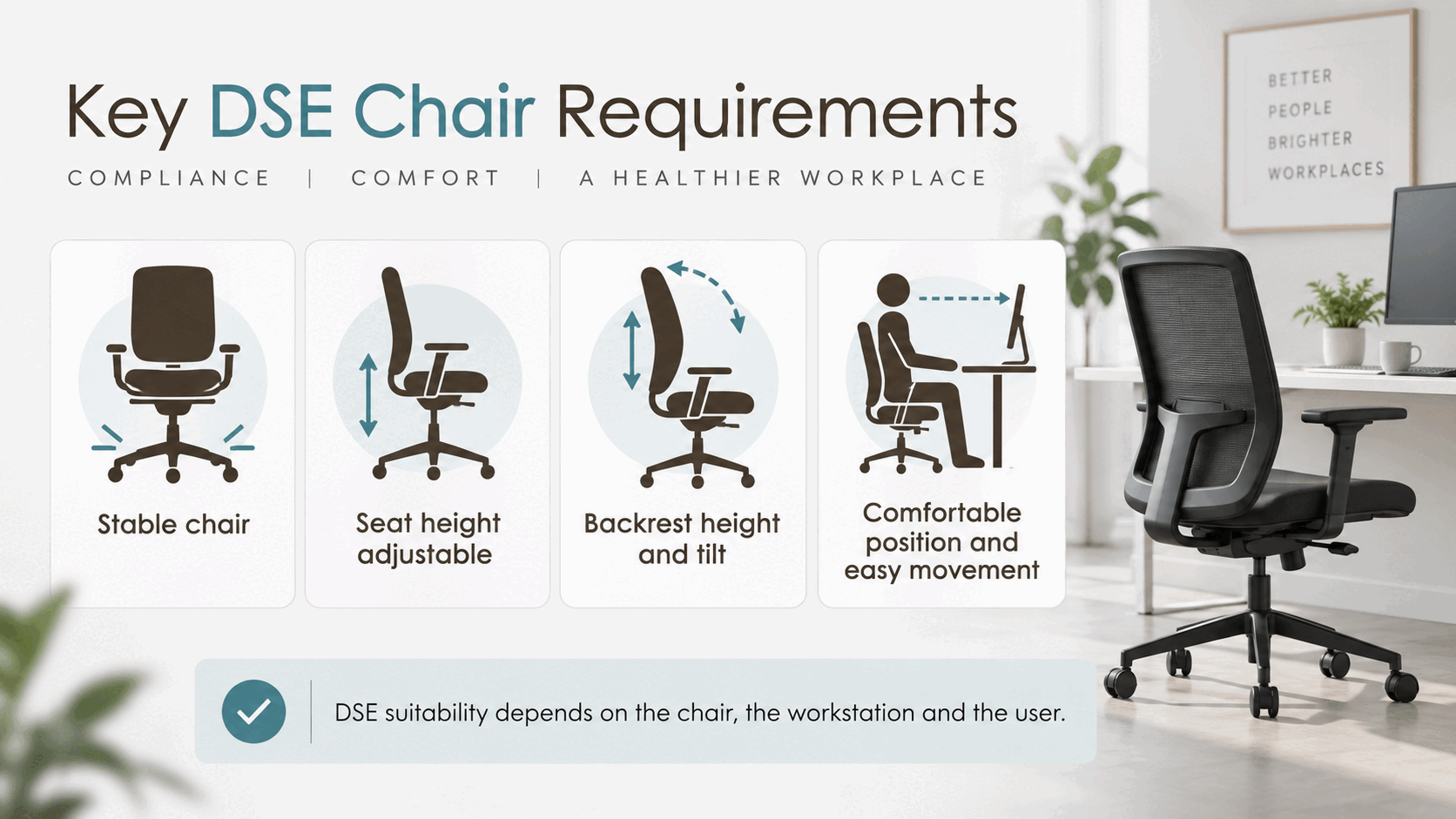
HSE guidance describes a DSE user as someone who uses display screen equipment daily, as part of their normal work, for continuous periods of an hour or more.
This can include people who work:
At a permanent office workstation
At different desks through hot-desking
From home on a permanent or long-term basis
Across home and office locations as part of hybrid working
On the move, where DSE forms a regular part of their work
Employers must look beyond the chair itself. A DSE assessment considers the whole workstation, including furniture, equipment, working conditions, the task and any individual requirements.
There is therefore no single office chair that automatically makes every workstation compliant. A suitable chair has to meet the relevant requirements and work properly for the person using it.
If you are sourcing seating for computer-based work, our DSE office chairs are a useful place to start.
The Schedule to the DSE Regulations sets out minimum workstation requirements. For work chairs, there are several key points.
A DSE chair should provide a stable seating position during normal use. The user needs to be able to sit, move and adjust their position without the chair feeling insecure.
The chair should allow the user to move easily and sit comfortably. Employers should consider whether the worker can sit close enough to the desk, operate their equipment comfortably and change position without the chair getting in the way.
Seat height adjustment is an explicit DSE requirement. The adjustment range should allow the user to position themselves appropriately in relation to the desk, keyboard and screen.
HSE posture guidance recommends positioning the user so their shoulders can remain relaxed and the keyboard is just below elbow height. Chair height is therefore part of the wider workstation set-up.
The regulations require the seat back to be adjustable in height and tilt. HSE guidance explains that these adjustments do not necessarily need to operate independently of the seat, provided the chair allows the user to achieve a comfortable posture.
Automatic backrest adjustment can also be acceptable where it provides adequate support.
The Schedule states that a footrest must be made available to an operator or user who wishes one. HSE also notes that a footrest may be necessary where a worker cannot rest their feet flat on the floor.
A footrest is not a universal requirement for every workstation. Its usefulness depends on the individual’s position and the relationship between the chair and work surface.
| DSE chair consideration | Legal minimum or practical consideration? | What employers should check |
|---|---|---|
| Stable chair | Legal requirement | Chair remains secure during normal use |
| Seat height adjustment | Legal requirement | User can set an appropriate working height |
| Backrest height and tilt | Legal requirement | Backrest can support a comfortable posture |
| Freedom of movement | Legal requirement | Chair does not restrict normal movement |
| Footrest availability | Legal requirement when requested | Provide one when requested and assess whether it is needed |
| Armrests | Not a universal legal requirement | They should not stop the user getting close to the desk |
| Lumbar adjustment | Ergonomic feature | Consider it where it helps meet assessed needs |
| Seat-depth adjustment | Ergonomic feature | Useful where more adjustment is needed for different body sizes |
Employers comparing different models can also browse our wider selection of used office chairs.
Lumbar support, adjustable armrests and seat-depth adjustment are often associated with ergonomic office chairs, but they are not all universal statutory DSE requirements.
The more important question is whether the chair allows the individual worker to achieve a comfortable, supported working position.
HSE’s posture guidance recommends good lower-back support and a small gap between the front of the seat and the back of the knee. Workers should also be able to keep their shoulders relaxed and position their arms comfortably.
Armrests can help some users, but they should not stop the chair moving close enough to the work surface.
Features such as adjustable lumbar support, seat-depth adjustment and advanced tilt mechanisms can be useful where workers spend long periods at their desks or where chairs are shared. Our guide to ergonomic office chairs for long hours explores these features in more detail.
A suitable chair should be chosen as part of a wider DSE assessment.
According to HSE guidance, employers should assess DSE workstations when:
A new workstation is set up
A new DSE user starts work
An existing workstation or the way it is used changes
A user reports pain or discomfort
The assessment should identify risks and the action needed to reduce them. Software or self-assessment forms can help, but HSE states that software alone is not an assessment. A trained assessor should review findings and make sure problems are addressed.
A practical chair assessment should consider:
Is the chair stable and in good working order?
Can the user adjust the seat height easily?
Can the backrest be adjusted appropriately?
Is the small of the back supported?
Can the user sit close enough to the desk?
Are the shoulders relaxed?
Can the forearms sit around horizontal when working?
Can the feet rest comfortably?
Is there excessive pressure behind the knees?
Does the user understand how the controls work?
One model may work well for many employees without being suitable for everyone. This matters particularly at shared workstations, where the chair needs enough adjustment for different users.
If an assessment identifies additional back-support needs, our guide to used office chairs for back pain explains some of the ergonomic features available on refurbished seating.
Start with the legal requirements, then consider what the individual user and workplace need in practice.
Look for a stable chair with suitable seat-height adjustment and a backrest that meets the DSE requirements for height and tilt. Controls should work correctly and hold their settings.
A chair with numerous controls is not automatically better if those controls do not suit the worker or are difficult to use.
People vary in height, leg length and body proportions. Useful factors to consider include:
Seat dimensions and depth
Backrest dimensions
Seat-height range
Armrest position
Space beneath the desk
Pressure behind the knees
A good chair should help the worker achieve an appropriate position rather than forcing them to adapt to the chair.
A chair assigned to one person may need less frequent adjustment. A hot-desk or shared chair may benefit from a broader adjustment range and simple controls.
For larger projects, facilities teams may also want to standardise a core chair model while retaining alternatives for employees whose assessments identify different needs. Our guide to choosing used office chairs covers wider points to consider when comparing refurbished seating.
Yes, where the worker falls within the scope of the DSE Regulations.
HSE says the regulations can apply to workers who work at home permanently or long term and to people who routinely divide their time between home and another workplace.
Where the regulations apply, employers should carry out an individual DSE assessment. In many cases, the worker can complete a self-assessment after receiving suitable training, so a home visit is not automatically necessary.
The assessment should determine whether additional equipment is needed. HSE also notes that conventional office furniture is not always necessary if the worker can achieve a comfortable, sustainable posture.
Equally, a dining chair or other household seating should not simply be assumed suitable for regular DSE work. The assessment should establish whether the set-up controls the relevant risks and meets the worker’s needs.
An adjustable chair is only useful if the person sitting in it knows how to adjust it.
Employers must provide DSE users with appropriate information and training. HSE says this should include:
Good posture
Adjusting chairs and other furniture
Arranging desk space
Adjusting screens and lighting
Breaks and changes of activity
Risk assessments
How to report problems
It is sensible to include chair adjustment when a new employee is introduced to their workstation and revisit it when equipment changes.
The law also requires DSE work to be interrupted by breaks or changes of activity. HSE does not prescribe one fixed legal break interval for every job. It advises that shorter, more frequent breaks are preferable to longer, less frequent ones where possible.
The DSE Regulations do not say that a work chair must be new. What matters is whether the chair and workstation meet the relevant requirements and whether the chair remains suitable for the user.
A refurbished chair should therefore be checked for:
Stability
Correct seat-height operation
Backrest adjustment
Smooth movement where applicable
Functional castors or glides
Controls that hold their settings
Suitable upholstery, padding or mesh condition
At The Office Chair Man, our refurbished seating is inspected and prepared before sale. Buyers who want to understand what to look for can read our guide to checking refurbished ergonomic office chair quality, which covers structural condition, mechanisms, adjustability and materials.
Businesses buying at scale should also consider model consistency, quantities, delivery planning and whether alternatives may be required for individual needs. Our facilities guide to bulk buying used office chairs covers these procurement considerations.
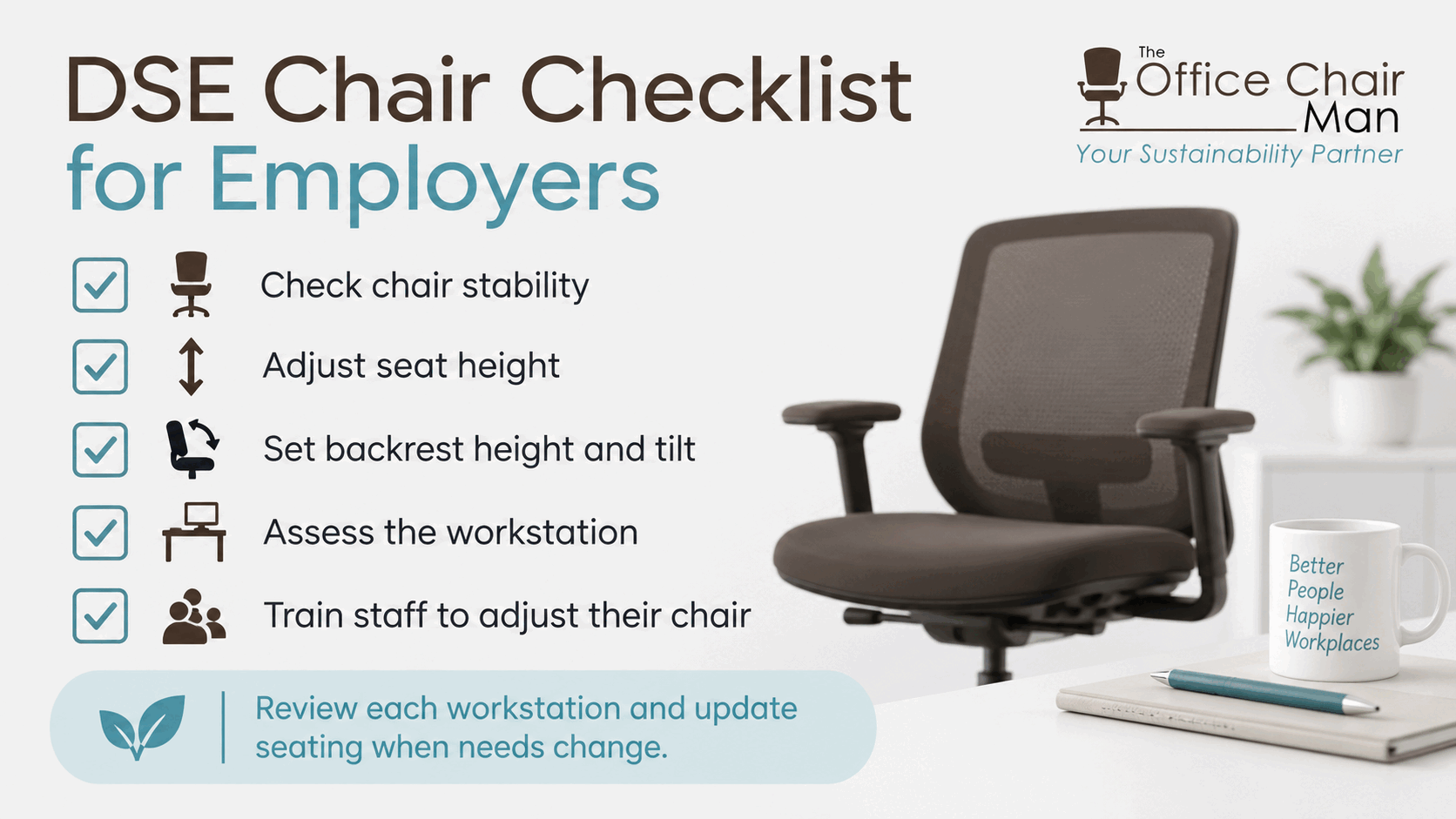
Before signing off a workstation, employers can use this chair-focused checklist:
Is the chair stable?
Is the seat height adjustable?
Can the backrest meet the required height and tilt adjustments?
Can the employee sit comfortably and move easily?
Is their lower back adequately supported?
Can they sit close enough to the desk?
Can their shoulders remain relaxed?
Can their feet rest comfortably, or is a footrest needed?
Are all adjustment mechanisms working?
Does the worker know how to use the controls?
Has the chair been considered as part of the complete DSE assessment?
Is the set-up reviewed when circumstances change?
DSE compliance is not about finding a sticker or a single chair model that can be declared suitable for everyone. The right approach is to assess the worker and workstation, identify risks and individual needs, provide appropriate equipment, explain how to use it and review the set-up when circumstances change.
For employers, that means choosing seating with the right core adjustments while remaining flexible enough to respond to individual assessments.
At The Office Chair Man, we stock refurbished seating for a wide range of office requirements, from standard task seating to DSE and orthopaedic models. If you are planning a workstation upgrade or office fit-out, our task operator seating range offers a broad selection of adjustable chairs for comparison.